


Do you have a head of sales or a top rep with extra meetings?
Antoine runs a SaaS scale-up between Paris and London. Last year he promoted Claire, his best rep – the one who was constantly beating quota and closed the enterprise deal everyone still talks about – to Head of Sales. He was proud of the move. Promoting from within, rewarding performance and yes, keeping payroll lean. Claire kept her personal quota, “for now, until the team ramps.”
Six months later, Antoine called me. The team wasn’t ramping. The two juniors were stuck at the same win rate as day one. Claire looked exhausted. And the pipeline was carried, almost entirely, by one person. Guess who.
Antoine wanted to talk about the team. Comp plans, maybe. Motivation. Perhaps the wrong hires? Process? Messaging?
These were all valid point but, stucturaly, I did I asked him one question instead: how much of Claire’s variable sits on her personal number?
Eighty percent.
There it was. The player-coach – when a company has a sales manager who carries a quota, hence “player” and “coach” – exists because a founder wanted leadership on a contributor’s salary – and the comp plan tells the truth. If 80% of the variable – or whatever substantial percentage – sits on personal quota, you didn’t hire or promote a coach. You turned a powerful rep into a rep with more meetings and admin.
The comp plan never lies
Founders tell me the player-coach is a development opportunity. A stepping stone. “The best of both worlds.” I understand the intent – I even respect the instinct to promote from within. But the org chart says one thing and the comp plan says another, and people always follow the money and so does the sales manager calendar.
When a deal wobbles at the end of the quarter or if it’s at risk in a customer facing situation, what does a player-coach do? She takes the call herself. She jumps in. Of course she does – it’s her number on the line. And every time she does, something quiet and corrosive happens: the rep learns that when it gets hard, someone else takes over.
It can be seen as coaching, but it isn’t, it’s simply rescue. And rescue creates dependency on the sales manager rather than developing a sales capability for the organisation. Underneath it sits a simple difference of wiring in the mind of sales professionals: a salesperson wants to be the hero. A sales manager’s job is to build heroes. Ask one person to be both, and every quarter-end, the “wings of the hero” win (see image of this blog post, the illusion of having both…).
Real coaching is almost the opposite of selling. Selling rewards taking control when coaching requires giving it up. A sales manager needs to let a rep struggle through a discovery call she could run better in her sleep, debriefing it afterwards, and resisting every instinct to grab the wheel. A player-coach can’t afford that patience because her very own forecast can’t afford it.
There’s a subtler problem too. Built-in competition. Let me explain. A manager who is also the top biller isn’t a peer to her team but the competition. Best leads, best deals, the CEO’s attention: she wins them all, because she’s the safest pair of hands. To the limit, and we have seen it, the reps aren’t being developed in her shadow, they are being kept there.
Selling DNA is not sales management DNA
Here’s the assumption buried inside every player-coach appointment: that your best seller will be a decent-enough coach. Nobody says it out loud, but it’s the load-bearing wall of the whole construct.
We assess salespeople and sales leaders for a living, and we can tell you from years of client work: the profile that makes someone brilliant at closing and the profile that makes someone effective at developing others are two different things. Sometimes they overlap in one person which is great. In my experience, not often – and never by accident. Promoting your top biller into a coaching role without checking whether she has the mental wiring for it is like making your best striker the club physio because she knows a lot about legs.
This isn’t guesswork, by the way – it’s measurable. When we run an OMG Sales Manager evaluation, the role is scored on three dimensions:
1- Mindset such as the true desire to manage a sales team – not just the title, the actual mission –
2- Sales DNA such as – but not only – the ability to challenge the sales team rather than being liked by it.
3- Technical competencies for being a sales manager.
And amongst the technical competencies that actually define a sales manager, there are four key ones: coaching, motivating, holding people accountable, and recruiting. See below the assessment of a sales manager profile. Or download full samples here.
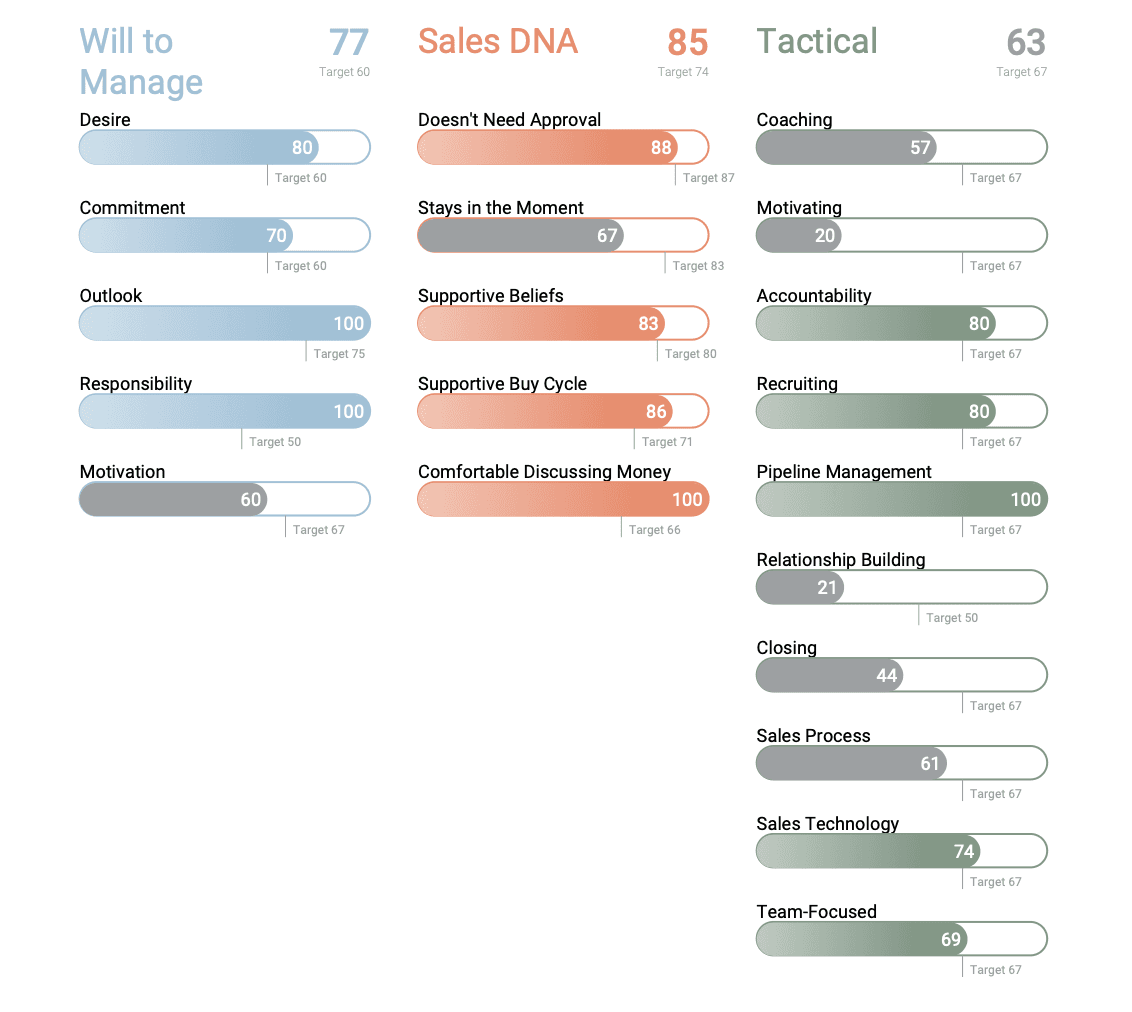
Not closing. Not personal pipeline. Not prospecting.
And of those four, coaching is the one everyone underestimates. It looks easy: watch a call, give feedback. Except that it’s not. Real coaching is an advanced skill which takes a long time to master. Asking instead of telling, working on beliefs and behaviours rather than just deal mechanics, coaching against a process, using a methodology and knowing when to stay silent. I’ve written before about the two types of sales coaching – and why one of them isn’t coaching at all, why great coaching starts with communication skills or why it starts with numbers, not gut feeling.
The short version: it’s a discipline in its own right, and a critical one. Which is exactly why bolting it onto a full personal quota never works.
We say this without judgement, by the way, because we at Curiosity we’ve been Claire. Earlier in our career we all carried a number and “led” a team at the same time, fuelled by caffeine and the sincere belief that we were different. The reality is that we weren’t. And when we truly look at our past experience, knowing what we know now, we realise our reps got the version of us that was left over after our own pipelines had eaten the day. Which is to say: not much.
The question to ask yourself
If you’re running a player-coach model today, we are not going to tell you to blow it up tomorrow. Sometimes it genuinely is a bridge – a few months while you decide what the sales function needs to become.
But be honest about what you’ve built. Look at the comp plan, not the job title. Look at the calendar, not the intention you had when appointing the person. If the variable says “seller” and the diary says “seller”, then you have a seller – and a team with no manager, wearing a name badge that says otherwise.
The real question isn’t whether your player-coach is working hard. She almost certainly is, I’d argue most likely too hard. The question is: what did you actually buy – or promoted if you promoted the top biller, something we often see -? Because sales management at a discount usually turns out to be neither…
Now Antoine changed the structure, by the way. Claire chose the leadership path, dropped the personal quota, we helped her skill up through sales management development track and it took her a full quarter to stop rescuing deals. The team is ramping now. Slower than the forecast wanted, change takes time. Faster than it ever would have otherwise.
But let’s be honest: that’s one ending, and not always the right one. Sometimes the truthful outcome of this conversation is the opposite – the player-coach goes back to full-time selling. And that’s where it gets emotionally expensive. Not financially: a great seller often earns more than the manager she reports to, and everyone in sales knows it. The obstacle is the ego. Ego is always the enemy as the expression goes. And it crytallises in one thing : the title. Telling your LinkedIn network, your family, yourself, that you’re “no longer Head of Sales.” It feels like a demotion when it’s actually a correction – putting an exceptional talent back where she creates the most value, and freeing the leadership seat for someone wired to fill it.
The companies that handle this well don’t frame it as a step down. They frame it as two career paths of equal standing – one that leads to bigger deals, one that leads to bigger teams – and they pay both properly. The companies that handle it badly leave the person and the title in place to spare feelings, and quietly keep the dysfunction on the payroll.